

The moment the board exam dates are announced, most homes change. Timetables go up on the wall, phones get taken away, and parents start offering advice: "Sit and revise." "Write it ten times." "Let me teach you."
The effort is real and the love behind it is real. But there is a question that often gets skipped: how does my child actually learn best?
In my decade of counselling students in Class 10 and 12, I have seen the same pattern again and again. Two children study the same chapter for the same two hours. One remembers it clearly. The other feels they have read it and still cannot recall it. The difference is rarely intelligence or sincerity. Very often, it is the method.
Every child has a learning preference
A learning preference is simply the way a child finds it easiest to take in and make sense of new information. You may recognise your child in one of these:
The listener. Learns best when someone explains it, whether a parent, teacher, friend or recorded lesson. Often likes to talk through a concept aloud, and may remember things said in class better than things read.
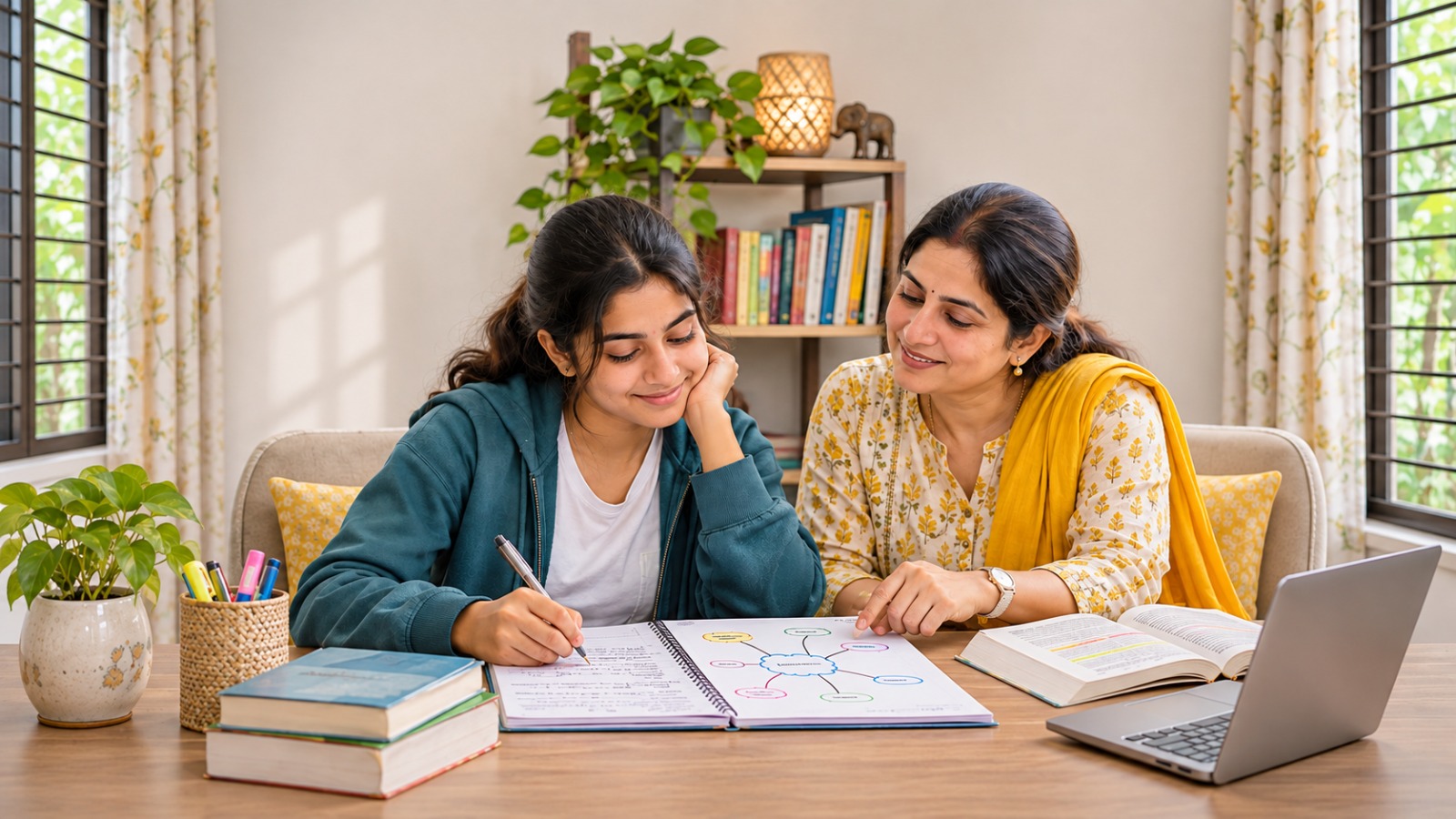
The watcher. Needs to see it. Diagrams, flowcharts, colour-coded notes, mind maps, working models and demonstration videos make ideas click. A science process or a geometry proof makes sense once they see it drawn or demonstrated.
The reader-writer. Learns by reading carefully and writing things down in their own words: summaries, lists, rewriting notes.
The doer. Understands by trying. Solving problems, doing experiments, using flashcards, taking mock tests and teaching the topic back to someone else.
Most children are a mix. But usually one or two ways feel clearly easier to them, and that is a useful starting point.
Why this matters more than extra hours
When a method suits a child, they stay engaged longer, feel less frustrated, and trust themselves more. When it does not, they can sit at a desk for hours and still feel "I just can't remember anything," which quietly damages confidence right when they need it most.
A gentle note: research shows that matching teaching only to a preferred style does not guarantee better results on its own. The strongest learning happens when a child's preferred way is used to begin understanding, and then proven techniques are layered on top: recalling without looking at the book, spaced revision, and practising previous papers. Think of preference as the doorway, and these habits as the rooms inside.
How parents can find out, without testing or labelling
You do not need an assessment to begin. Simply observe and ask over a few days:
Notice what already works. Which chapter did they enjoy last term, and how did they study it?
Ask curious questions. "When you really understood something, what helped?" "Would you like me to explain it, or would you like to figure it out with a diagram first?"
Offer small experiments. Try one topic three ways, such as listening to an explanation, drawing it out, and solving questions on it. Then ask which felt easiest and which stuck better the next day.
Check, don't assume. Test recall the next day. What a child remembers tells you more than how long they studied.
Let them lead. A child who has chosen their own method owns their preparation.
What this looks like at home
If your child is a listener, let them explain a topic to you at dinner, or record voice notes of key points to replay.
If your child is a watcher, help them convert chapters into one-page mind maps, charts and colour-coded notes.
If your child is a reader-writer, encourage summary notes in their own words and short written answers to practise.
If your child is a doer, plan problem-solving sessions, timed practice and flashcards. Let them teach you a concept.
One caution
Your role is not to become the teacher for every subject. It is to create the conditions: a calm space, regular sleep and meals, breaks, and a listening ear. Understanding your child's way of learning is one of the kindest forms of support, because it tells them, "I see how you work, and I trust you."
The board exams are a few months of a very long journey. A child who learns how they learn carries that skill into college, careers and life.
If your child is struggling to find a study method that works, or exam stress is affecting their sleep, mood or confidence, a conversation with a counsellor can help. At Agam Forte, we work with students and parents in Chennai on exactly this. Reach out to book a session.
